| 
|
(Phylloscopus borealis)
| Visual data presentation | Summary of means | Pairwise correlations | |
|---|---|---|---|
| Temporal | |||
| Spatial |
before reading the individual species account narrative below
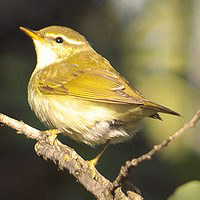
Arctic Warbler, a rather uncommon breeding species of dense riparian willow thickets in western Alaska, was fairly well represented in the 1992-2006 MAPS database, considering its limited range in the western half of Alaska: 259 adult individuals were banded and 52 between-year recaptures of adults were recorded at 2 stations in the single Bird Conservation Region (Northwestern Interior Forest BCR 4) within which it was captured. As shown in the temporal display of results, however, all of the Arctic Warbler captures occurred during the 11 years 1992-2002, after which the operation of stations in Denali National Park, where all of the captures reported on this website occurred, was discontinued. Because Artic Warbler was captured in only one BCR, no measure of spatial variability was available for any demographic parameter and no spatial correlations could be performed among any vital rates.
Temporal analyses of 1992-2006 program-wide MAPS data showed a weighted mean population density index for Arctic Warbler of 9.1 adults per station, a density that was over three times as high as the analogous mean density index for all species on the website. Analogous spatial analyses, however, produced a density index of only 4.4 adults per station, which also was high, but only about 20% higher than the analogous mean density index for all species. These indices for Arctic Warbler indicate the very high adult population density that can be reached for this locally distributed species. Annual variability in population density (49.2%) was also high, about twice as high as the analogous mean variability for all species. The linear time model for the index of adult population density for Arctic Warbler produced a significantly negative Beta of -0.089, suggesting a significant population decline during the 11 years for which data were available.
The weighted geometric mean of the model-averaged annual lambda estimates (0.921, which was not significantly different from 1.0) indicated a strongly but non-significantly decreasing population for Arctic Warbler, while the BCR-constant lambda estimate (0.914, which was significantly different from 1.0) indicated a strongly and significantly decreasing population. These estimates agreed with the population decline suggested above by the linear time model for adult population density. No population trend estimate, however, was available for Arctic Warbler from the 1992-2006 North American Breeding Bird Survey. The annual variability of lambda for Arctic Warbler (39.7%), like the analogous variability for the index of adult population density, was high, over 70% as high as the analogous mean for all species on the website.
Temporal and spatial analyses produced estimates for adult apparent survival for Arctic Warbler (0.337 and 0.334, respectively) that were very low, even considering the relatively low body mass of this species compared to the body masses of all other species on the website. Indeed, only Nashville and Pine warblers had equally low adult apparent survival estimates, and only Golden-crowned Kinglet had lower estimates. Although these estimates for Arctic Warbler were likely deficient and probably were one cause of the species’ population decline, we suspect that, like the situation for Golden-crowned Kinglet, they reflect a low breeding site fidelity and high emigration rate, as well as a low true survival rate. Annual variability in adult apparent survival for Arctic Warbler (41.4%), like the annual variabilities for both its index of adult population size and lambda, was high, about 75% higher than the analogous mean variability for all species.
Temporal and spatial analyses produced estimates for the productivity index for Arctic Warbler (0.114 and 0.083, respectively, from the selected models) that were very low, only about 30% and 20% as high, respectively, as the analogous mean estimates for all species on the website. These indices, like the estimates for adult apparent survival of Arctic Warbler, were very low, and were likely to have been deficient and an important driver of the population decline of the species. Moreover, these very low Arctic Warbler productivity indices were very different from the high productivity indices characteristic of a number of other species with low body masses and low adult apparent survival estimates, but with generally stable or increasing populations. Annual variability in productivity for Arctic Warbler (40.0%), unlike annual variability in both lambda and adult apparent survival, was not particularly high, being quite similar to the analogous mean variability for all species (42.5%).
Temporal analyses among Arctic Warbler vital rates showed that lambda was very strongly and significantly positively correlated with post-breeding effects, and moderately but non-significantly positively correlated with both productivity and adult apparent survival. These results suggest that annual variation in lambda (and likely the overall population decline of the species) was driven by annual variation in all three vital rates, but primarily by annual variation in post-breeding effects. Because of Arctic Warbler’s very low adult apparent survival rate, it seems likely that annual variability in post-breeding effects primarily reflected annual variability in first-year survival of young during the non-breeding season, but annual variability in recruitment of surviving young during the subsequent breeding season may also have been involved. Post-breeding effects were rather weakly and non-significantly negatively correlated with productivity, but were moderately but non-significantly positively correlated with adult apparent survival, suggesting possible competitive interactions among young birds, but not between young and adult birds. This further suggests that a density-independent effect (possibly wind and weather variables on the migration route) also may have affected survival of both adult and young birds. As perhaps expected from the latter two correlations, adult apparent survival was moderately but non-significantly negatively correlated with productivity.
Temporal analyses also showed that lambda was moderately but non-significantly negatively correlated with the index of adult population density, suggesting that the population dynamics of Arctic Warbler were effected, at least to some extent, in a density-dependent manner. In addition, all three other vital rates were also negatively correlated with adult population density in the following decreasing order of strength: post-breeding effects, productivity, and adult apparent survival, although none of these three correlations were significant. These results suggest that the density-dependent population regulation for Arctic Warbler was potentially brought about by all three vital rates, but most strongly by post-breeding effects. These results further indicate that the vital rate for which its annual variation was the strongest driver of annual variation in lambda was the same vital rate through which density dependence was primarily effected, a situation which tended to be somewhat unusual among the migratory landbird species included on this website.
Summary of research and management hypotheses – We suggest first that additional and more widespread population and demographic monitoring of Arctic Warbler in Alaska be conducted to determine the full temporal and spatial extent of the species’ population decline that was indicated here by 11 years of MAPS data from Denali National Park. If the species’ population decline proves to be temporally and spatially robust, we suggest that research and management efforts to reverse the decline and promote stable or increasing populations should first be directed toward determining and enhancing the habitat characteristics on the breeding grounds associated with higher levels of site-fidelity of adults and recruitment of young, especially during years when adult apparent survival and post-breeding effects are low and appear to drive population declines. These habitat characteristics are likely to be similar to those associated with higher breeding densities of Arctic Warblers. Second, however, because overall productivity for Arctic Warbler appeared also to be very low and tended also to be positively temporally correlated with lambda, we suggest that research and management efforts should also be directed toward determining and enhancing the habitat characteristics associated with high productivity on the breeding grounds, which may or may not be similar to those that promote high breeding densities of the species. Because all of the vital rates just discussed are likely to be strongly affected by weather, and because weather at the high latitudes of the Arctic Warbler’s breeding range has been shown to be strongly affected by climate change, we suggest that the research and management efforts suggested above include detailed consideration of both weather and climate change. In addition, because both first year survival of young and annual survival of adults were likely to be major drivers of the population decline of Arctic Warbler, we suggest that considerable information regarding the migratory connectivity of Alaskan breeders, as well as research and management to enhance habitat characteristics on the species Southeast Asian wintering grounds – habitat characteristics that promote higher survival of both young and adult birds – might well be needed to reverse the species population decline.
Please cite this narrative as: DeSante, D. F., D. R. Kaschube, and J. F. Saracco. 2015. Vital Rates of North American Landbirds. www.VitalRatesOfNorthAmericanLandbirds.org: The Institute for Bird Populations.