
| 
|
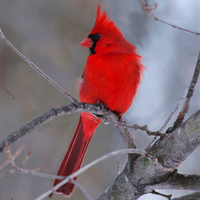
(Cardinalis cardinalis)
| Visual data presentation | Summary of means | Pairwise correlations | |
|---|---|---|---|
| Temporal | |||
| Spatial |
before reading the individual species account narrative below
Northern Cardinal, a common and widespread eastern permanent resident species, was very well represented as the eighth most frequently captured species in the 1992-2006 MAPS database. 10,672 adult individuals were banded and 2,381 between-year recaptures were recorded at 262 stations located within 17 Bird Conservation Regions (BCRs) in eastern U.S. and southeastern Canada and 1 BCR, Sierra Madre Occidental, in the Southwest. As shown on the spatial display of results, large numbers of captures were widespread over the species’ range, with over 750 adult individuals being captured in each of nine BCRs.
Mean temporal and spatial estimates of the index of adult population density (4.3 and 5.8 birds per station, respectively) differed less from each other than did analogous estimates for more heterogeneously distributed species. These adult population indices, moreover, were relatively high, being nearly 50% and 33% higher than the respective mean estimates for all species in the database, thus attesting to the overall high relative abundance of Northern Cardinals. Annual variability (CV) in adult population density (9.0%) was low, only about one-third of the mean annual variability for all species, suggesting a fairly stable population for this species. Indeed, the annual variability in population density was roughly similar to analogous annual variabilities for several warbler species with generally stable populations, such as Ovenbird, Kentucky Warbler, and Yellow-breasted Chat. In sharp contrast, spatial variability in population density for Northern Cardinal was high (60.8%), about 50% higher than the mean for all species and similar to that for Summer Tanager, another primarily southeastern species with an isolate population in the Southwest. The linear time model for the index of adult population density produced a Beta of 0.001 birds per station per year, again suggesting an overall stable population.
The weighted geometric means of the model-averaged annual and BCR-specific estimates of lambda (0.994 and 0.997, respectively, neither of which was significantly different from 1.0) supported the above suggestions and indicated a stable overall population. These estimates were somewhat similar to the 1992-2006 survey-wide lambda from the North American Breeding Bird Survey (BBS; 1.005), which indicated a slightly, but significant, increasing population trend. The difference between MAPS and BBS lambdas could have resulted from the roadside nature of BBS data which likely included more habitat with human occupancy, a habitat type especially favored by Northern Cardinals, than was found at MAPS stations. Both annual and spatial variabilities of lambda (9.7% and 1.9%, respectively) were low, only about 40% of the respective mean variabilities for all species, and further indicated that the roughly stable population trend for this species was widely consistent over both time and space.
Temporal and spatial estimates of adult apparent survival (0.572 and 0.573, respectively) were almost identical and, although somewhat lower than the temporal estimate for the lighter Summer Tanager, were very similar to the estimates for each of the closely related Pheucticus grosbeaks and were unlikely to have been deficient. Both annual and spatial variabilities in adult apparent survival (8.2% and 6.1%, respectively) were also very low and, similarly to analogous variabilities in lambda, were only about 40% of the respective mean variabilities for all species.
Temporal and spatial analyses also produced very similar mean estimates for productivity (0.313 and 0.321, respectively, from the selected models) which, while still about 25% less than the respective means for all species, were substantially higher than those for the three tanagers and two Pheucticus grosbeaks in the MAPS database. Annual and spatial variabilities in productivity (30.7% and 29.7%, respectively) were also low, nearly 30% and 40% lower than the respective mean variabilities for all species. It seems likely that the low annual and spatial variabilities of Northern Cardinal vital rates, including lambda, adult apparent survival, and productivity, result at least in part from its non-migratory behavior.
Temporal correlations between lambda and other vital rates for Northern Cardinal showed that lambda was strongly and highly significantly positively correlated with productivity; moderately but non-significantly correlated with adult apparent survival; and not correlated at all with post-breeding effects. Post-breeding effects were strongly and significantly negatively correlated with productivity, but adult apparent survival was not correlated at all with either productivity or post-breeding effects. These results suggest that annual variation in lambda was driven almost entirely by annual variation in productivity and only to a minor degree by annual variation in adult apparent survival.
Temporal analyses also showed that lambda was strongly and significantly negatively correlated with the index of adult population density, indicating that population regulation in Northern Cardinal was effected to some degree by density dependence. In addition, both productivity and post-breeding effects were moderately but non-significantly negatively correlated with adult population density, while adult apparent survival showed no correlation at all with population density, suggesting that density dependence was effected through productivity and, likely, by the probability of young birds to recruit into the breeding population, which, as indicated above, was inversely correlated with productivity. These results further suggest that the positive temporal relationship between adult apparent survival and lambda was driven by density-independent factors that most likely include severe weather during the winter season.
Spatial correlations between lambda and other vital rates were generally rather weak and all were non-significant, the strongest being a moderately strong and nearly significant positive correlation between lambda and post-breeding effects. This suggests that spatial variation in lambda was primarily driven by spatial variation in post-breeding effects, which likely reflected spatial variation in first-year survival of young, which probably in turn reflected spatial variation the severity of winter weather. As with temporal correlations, post-breeding effects were significantly negatively correlated with productivity, but the strength and significance of these spatial correlations were even greater than for the temporal correlations. In addition, unlike the temporal correlations, spatial correlations between post-breeding effects and adult apparent survival were also significantly negative, further suggesting that spatial variation in lambda was being driven in a density-dependent manner by first-year survival of young.
Summary of research and management hypotheses – Because of the stable or increasing population trends of Northern Cardinal, especially in association with landscapes characterized by moderate human disturbance levels, research and management efforts for the species are not needed. Nevertheless, we suggest that if research and management efforts are undertaken to maintain the increasing population trends, they should first attempt to determine and enhance the habitat types and characteristics associated with high productivity, especially in those years when overall productivity is low. Secondly, research and management should be directed at determining and increasing habitat types and characteristics associated with high overwintering survival of both adult and young birds, especially during years and in areas where survival is low as a result of adverse weather conditions.
Please cite this narrative as: DeSante, D. F., D. R. Kaschube, and J. F. Saracco. 2015. Vital Rates of North American Landbirds. www.VitalRatesOfNorthAmericanLandbirds.org: The Institute for Bird Populations.